Full Report
The numbers behind Ghitha Holding P.J.S.C: as-reported financial statements and company metrics for FY2021–FY2025, traced to the source filings, opened with the share-price history those statements have to justify. Every linked figure opens the exact page of the filing it was printed on, with the statement row highlighted. Amounts in AED thousands unless noted.
Reading notes: All values are shown in AED thousands. The FY2023-FY2025 annual reports and all interim reports present figures in AED thousands; the FY2020-FY2022 annual reports present figures in full dirhams, which have been converted to thousands for display (citation anchors point to the full-dirham figure as printed). FY2022 column figures are the FY2022 comparative column of the FY2023 annual report; FY2021 column figures are the FY2021 comparative column of the FY2022 annual report. The corpus contains no standalone FY2021 annual report. FY2024 profit was inflated by a one-off AED 2,654,652 thousand gain on the derecognition of a subsidiary (Apex Investment PSC, note 6.7); underlying continuing-operations profit before tax was AED 243,429 thousand in FY2025 vs AED 2,880,290 thousand (incl. the gain) in FY2024. The Group restated its reportable segments during FY2024 from a service/business cut (consumer goods, catering, facility management, manufacturing, contracting) to a product cut (fruits vegetables, dairy protein, trading distribution, edible oil fats, investment others), restating the FY2023 comparative. A consistent segment mix is therefore available only from FY2024, so the Revenue-by-Segment and Gross-Profit-by-Segment tables start at FY2024.
Share Price — Available History Since January 2026
The stock closed at AED 11.30 on Jul 31, 2026 — down 33% over the window shown, trading between AED 10.36 and AED 17.14. At that close the stock trades at 75× FY2025 diluted EPS as reported below.
Source: market price feed, daily closes, Jan 2026–Jul 2026 — the feed marks this available history as partial. Price return only, excludes dividends.
Market capitalization AED 2.7bn.
Market cap = 241.6M shares outstanding × the Jul 31, 2026 close of AED 11.30. Market-derived, shown without filing links.
FY2025 at a Glance
Net income (AED thousands)
Diluted EPS
Source: FY2025 consolidated statements [1] [2] [3] [4]. Click any linked figure to open the filing page with the row highlighted.
Revenue by Segment
| Revenue by Segment | FY2021 | FY2022 | FY2023 | FY2024 | FY2025 |
|---|---|---|---|---|---|
| Fruits and vegetables | — | — | — | 1,453,567 | 1,529,982 |
| Dairy and protein | — | — | — | 1,859,317 | 2,353,994 |
| Trading and distribution | — | — | — | 965,851 | 1,006,801 |
| Edible oil and fats | — | — | — | 687,935 | 767,069 |
| Investment and others | — | — | — | 67,221 | 0 |
| Inter-segment eliminations | — | — | — | (65,853) | (77,686) |
| Total revenue from contracts with customers | — | — | — | 4,968,038 | 5,580,160 |
| Total revenue from contracts with customers growth, derived | — | — | — | — | +12.3% |
Source: Note 33 Segment Reporting (revenue from contracts with customers by reportable segment) [5] [6]. Click any linked figure to open the filing page with the row highlighted.
Gross Profit by Segment
| Gross Profit by Segment | FY2021 | FY2022 | FY2023 | FY2024 | FY2025 |
|---|---|---|---|---|---|
| Fruits and vegetables | — | — | — | 208,782 | 249,472 |
| Dairy and protein | — | — | — | 549,344 | 732,266 |
| Trading and distribution | — | — | — | 160,705 | 158,702 |
| Edible oil and fats | — | — | — | 44,252 | 59,216 |
| Investment and others | — | — | — | 14,602 | 0 |
| Inter-segment eliminations | — | — | — | 0 | 183 |
| Total gross profit | — | — | — | 977,685 | 1,199,839 |
Source: Note 33 Segment Reporting (segment gross profit) [5] [6]. Click any linked figure to open the filing page with the row highlighted.
Income Statement
Source: Consolidated Statement of Profit or Loss [1] [2] [3] [4]. Click any linked figure to open the filing page with the row highlighted.
Balance Sheet
Source: Consolidated Statement of Financial Position [7] [8] [9] [10]. Click any linked figure to open the filing page with the row highlighted.
Cash Flow
| Cash Flow | FY2021 | FY2022 | FY2023 | FY2024 | FY2025 |
|---|---|---|---|---|---|
| Net cash from operating activities | 49,396 | 162,743 | 633,123 | 370,288 | 425,874 |
| Additions to property, plant and equipment | (11,939) | (107,504) | (450,417) | (114,393) | (118,889) |
| Net cash used in investing activities | (29,050) | (432,269) | (568,142) | (537,999) | (535,664) |
| Net cash from financing activities | (9,830) | 561,821 | 255,329 | (173,036) | 174,048 |
| Net increase (decrease) in cash and cash equivalents | 10,516 | 292,295 | 320,310 | (340,747) | 64,258 |
| Cash and cash equivalents at end of the year | 171,394 | 453,294 | 771,841 | 426,816 | 491,841 |
| Free cash flow, derived | 37,457 | 55,239 | 182,706 | 255,895 | 306,985 |
Source: Consolidated Statement of Cash Flows [11] [12] [13] [14]. Click any linked figure to open the filing page with the row highlighted.
Capital by Segment
| Capital by Segment | FY2021 | FY2022 | FY2023 | FY2024 | FY2025 |
|---|---|---|---|---|---|
| Fruits and vegetables | — | — | — | 1,076,973 | 1,278,769 |
| Dairy and protein | — | — | — | 2,898,309 | 3,511,620 |
| Trading and distribution | — | — | — | 800,168 | 716,519 |
| Edible oil and fats | — | — | — | 246,654 | 293,126 |
| Investment and others | — | — | — | 4,762,901 | 4,610,399 |
Source: company filings [5]. Click any linked figure to open the filing page with the row highlighted.
Operating Cost Structure
| Operating Cost Structure | FY2021 | FY2022 | FY2023 | FY2024 | FY2025 |
|---|---|---|---|---|---|
| Staff costs (total) | — | 224,786 | 484,614 | 464,346 | 547,042 |
| Rent, utilities and transportation | — | — | 100,881 | 143,402 | 169,164 |
| Sales promotion and marketing | — | — | 18,531 | 47,857 | 95,250 |
| Amortisation of intangible assets | — | — | 16,238 | 17,224 | 24,698 |
Source: company filings [15] [16] [17] [18]. Click any linked figure to open the filing page with the row highlighted.
Working Capital Asset Quality
| Working Capital Asset Quality | FY2021 | FY2022 | FY2023 | FY2024 | FY2025 |
|---|---|---|---|---|---|
| Inventories - finished goods | — | — | 201,591 | 306,729 | 394,515 |
| Allowance for slow-moving inventories | — | 7,778 | 17,355 | 24,954 | 29,583 |
| Allowance for expected credit losses on receivables | — | 66,830 | 81,571 | 84,377 | 91,507 |
| Expected credit loss charge for the year | — | 21,439 | 1,682 | 16,908 | 18,983 |
Source: company filings [19] [20] [21] [22]. Click any linked figure to open the filing page with the row highlighted.
Farming Biological Assets
| Farming Biological Assets | FY2021 | FY2022 | FY2023 | FY2024 | FY2025 |
|---|---|---|---|---|---|
| Biological assets (year-end) | — | — | 177,034 | 190,340 | 235,157 |
| Additions to biological assets | — | — | — | 88,651 | 97,160 |
| Change in valuation of biological assets, net | — | — | — | 15,247 | 32,615 |
| Depreciation of biological assets | — | — | — | 40,773 | 54,243 |
Source: company filings [23]. Click any linked figure to open the filing page with the row highlighted.
Funding IHC Group Flows
| Funding IHC Group Flows | FY2021 | FY2022 | FY2023 | FY2024 | FY2025 |
|---|---|---|---|---|---|
| Long-term bank loans | — | — | — | 701,350 | 992,388 |
| Short-term bank loans | — | — | — | 132,147 | 154,416 |
| New borrowings drawn during the year | — | 577,580 | 439,374 | 457,196 | 972,282 |
| Revenue from related parties (IHC group) | — | 612,619 | 657,051 | 638,409 | 537,109 |
| Purchases from related parties (cost of goods sold) | — | 15,533 | 91,144 | 37,996 | 31,585 |
| Dividend declared to non-controlling interests | — | — | — | 63,345 | 66,502 |
Source: company filings [24] [25] [26] [27]. Click any linked figure to open the filing page with the row highlighted.
Long-Term Record
| Fiscal year | Total revenue | Operating profit | Profit attributable to owners | Basic and diluted EPS | Operating cash flow | Total equity |
|---|---|---|---|---|---|---|
| FY2018 | 286,381 | 18,572 | 18,526 | — | (7,536) | — |
| FY2019 | 302,999 | 19,103 | 18,636 | 1.21 | 41,698 | 139,630 |
| FY2020 | 289,029 | 12,773 | 12,295 | 0.80 | 25,158 | 161,401 |
| FY2021 | 545,621 | 30,439 | 57,625 | 0.58 | 49,396 | 963,330 |
| FY2022 | 2,278,566 | 155,249 | 281,718 | 1.44 | 162,743 | 3,797,114 |
| FY2023 | 4,566,913 | 254,401 | 30,330 | 0.13 | 633,123 | 4,414,806 |
| FY2024 | 4,968,038 | 228,668 | 2,556,135 | 10.58 | 370,288 | 6,672,081 |
| FY2025 | 5,580,160 | 318,677 | 36,508 | 0.15 | 425,874 | 6,868,483 |
Source: consolidated statements across filings; older years from the standardized feed [12] [1] [8] [14]. Click any linked figure to open the filing page with the row highlighted.
Analyst Consensus
Mean target
Street ratings: No sell-side analyst coverage. Ghitha Holding P.J.S.C (ADX:GHITHA) is covered by 0 analysts, so there is no consensus price target and no buy/hold/sell rating breakdown available from any reputable aggregator (Simply Wall St, Investing.com). Simply Wall St shows only a proprietary model fair-value estimate (~AED 73), which is not an analyst consensus target.
Estimate source: analyst consensus (claude_web), as of 2026-07-31. Forecasts carry no filing page links.
Traceability
315 of 325 figures on this page (97%) link to the filing page where they are printed — click a linked figure to open the source PDF at that page with the row highlighted. Unlinked figures come from standardized data feeds or pre-filing years.
All values are shown in AED thousands. The FY2023-FY2025 annual reports and all interim reports present figures in AED thousands; the FY2020-FY2022 annual reports present figures in full dirhams, which have been converted to thousands for display (citation anchors point to the full-dirham figure as printed).
FY2022 column figures are the FY2022 comparative column of the FY2023 annual report; FY2021 column figures are the FY2021 comparative column of the FY2022 annual report. The corpus contains no standalone FY2021 annual report.
FY2024 profit was inflated by a one-off AED 2,654,652 thousand gain on the derecognition of a subsidiary (Apex Investment PSC, note 6.7); underlying continuing-operations profit before tax was AED 243,429 thousand in FY2025 vs AED 2,880,290 thousand (incl. the gain) in FY2024.
The Group restated its reportable segments during FY2024 from a service/business cut (consumer goods, catering, facility management, manufacturing, contracting) to a product cut (fruits vegetables, dairy protein, trading distribution, edible oil fats, investment others), restating the FY2023 comparative. A consistent segment mix is therefore available only from FY2024, so the Revenue-by-Segment and Gross-Profit-by-Segment tables start at FY2024.
Discontinued operations were first presented in the FY2024 report and comparatives were restated. Each year's income-statement, balance-sheet and cash-flow figures are cited to that year's own annual report as originally reported; consequently FY2024 revenue (4,968,038) differs from the restated FY2024 comparative shown in the FY2025 report (4,915,873).
The quarterly income statement uses the three-month columns printed in each interim report; Q4 FY2025 is not shown because Ghitha files no standalone fourth-quarter interim report.
Ghitha Holding PJSC was formerly Zee Store PJSC (renamed January 2022) and is part of the International Holding Company (IHC) group; the step-change in scale from FY2021 to FY2023 reflects business combinations of entities under common control (reverse acquisitions), not organic growth.
5 figure(s) differed between the data feed and the filing; the filing value is shown (see the run's metrics/metrics_tab.json for the audit trail).
Ghitha Holding P.J.S.C's annual reports contain management's most considered account of the business. These are the sections, passages and visual pages worth opening in the originals preserved in Sources.
Ghitha Holding PJSC — FY2025 Annual Report (Consolidated Financial Statements) — FY2025
Latest report: revenue up to AED 5.58bn, a new parent (Two Point Zero), and the poultry roll-up that shows how the group grows. · Open the full document →
Directors' Report — p. 3 · Read the full section →
The only management-voice page — its headline is that 2025 revenue grew but profit fell sharply as 2024's one-off gain washed out.
Revenue rose ~14% to AED 5.58bn, but continuing-ops profit fell to AED 213m from AED 2.86bn a year earlier.
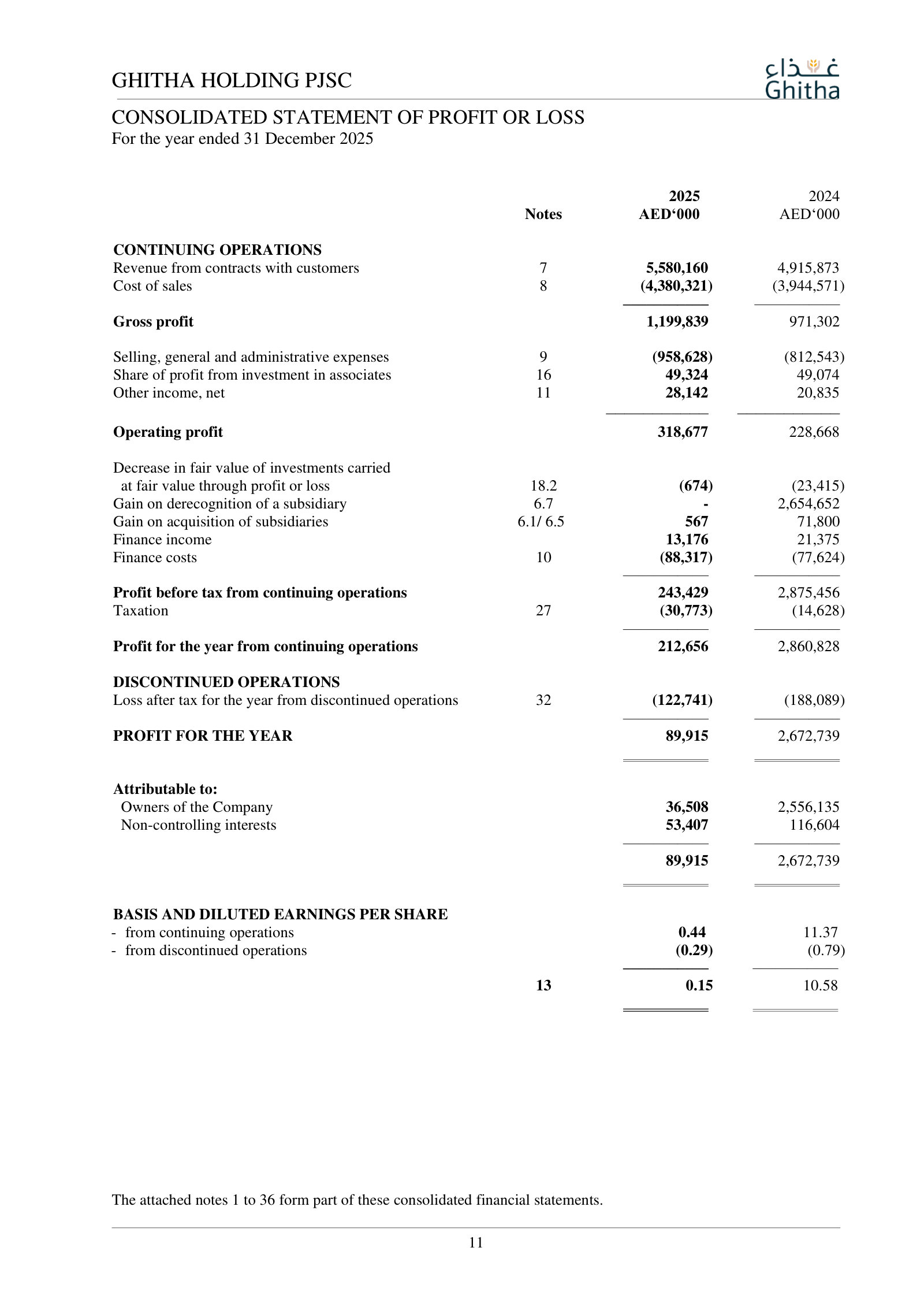
Revenue for the year from continuing operations amounted to AED 5,580,160 thousand (2024: AED 4,915,873 thousand) and profit for the year from continuing operations was AED 212,656 thousand (2024: AED 2,860,828 thousand).
p. 3 · Read in context →
Independent Auditor's Report — Key Audit Matters — p. 4 · Read the full section →
Deloitte flags the two areas of most judgement: recognising a high-volume, multi-stream revenue base and valuing the year's acquisitions.
Note 1 — General Information — p. 18 · Read the full section →
Discloses a control change: IHC Food Holding handed the company to Two Point Zero Group (ex-Multiply) in late 2025 — a new parent atop the IHC orbit.
New parent from 30 November 2025 — shares transferred from IHC Food Holding to Two Point Zero Group PJSC.
During the year, IHC Food Holding LLC, the former Parent of the Company, transferred its entire shareholding in the Company in an extra ordinary general meeting to Two Point Zero Group PJSC (“2Point Zero”) (formerly, Multiply Group PJSC), as a result of which 2Point Zero became the Parent of the Company, effective 30 November 2025
p. 18 · Read in context →
Consolidated Statement of Profit or Loss — p. 13 · Read the full section →
Shows earnings quality plainly: operating profit grew, but 2024's AED 2.65bn gain on derecognising a subsidiary — not trading — is why headline profit collapsed year-on-year.
Note 3 — Material Accounting Policies: Revenue Recognition — p. 28 · Read the full section →
The policy that defines the business model — a food distributor recognising revenue at the point control passes on delivery.
Revenue is booked at a point in time — when goods are delivered to the customer's location.
The Group recognises revenue from sale of food and non-food items at a point in time. Sales of goods to the customers mainly include one performance obligation, revenue is recognised when control of the goods has transferred, being when the goods have been shipped to the customer’s specific location (delivery).
p. 28 · Read in context →
Note 6 — Business Combinations — p. 51 · Read the full section →
The growth engine in detail — the group builds by acquiring, this year two Dubai poultry/egg farms folded into Al Ain Farms.
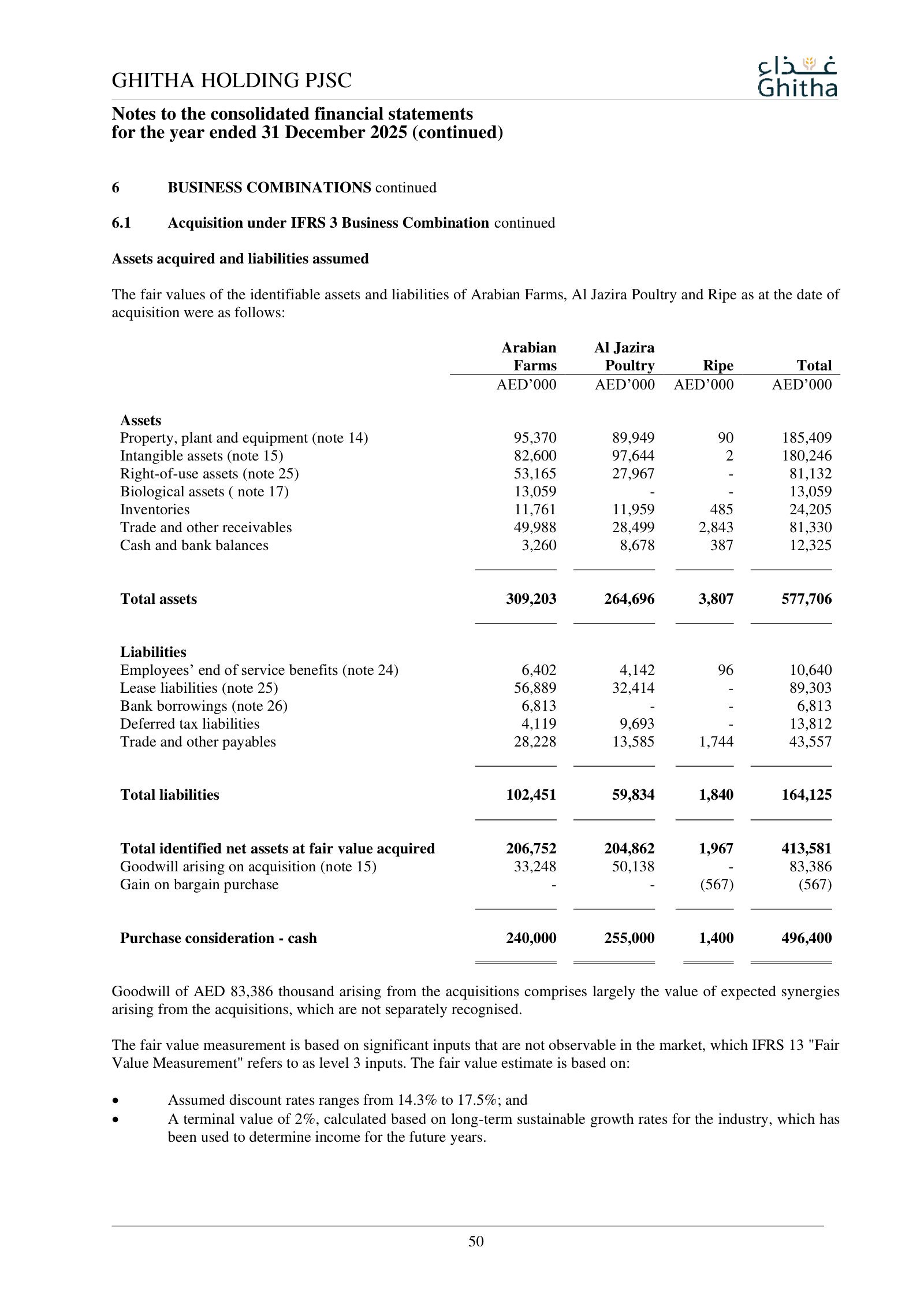
2025 acquisitions: Arabian Farms (AED 240m) and Al Jazira Poultry (AED 255m), both bought via Al Ain Farms.
Effective 1 January 2025, Al Ain Farms for Livestock Production PJSC (“Al Ain Farms”), a subsidiary under the Group, acquired a 100 per cent equity interest in Arabian Farms Investment LLC (“Arabian Farms”) for a cash consideration of AED 240,000 thousand. […] Effective 1 May 2025, Al Ain Farms for Livestock Production PJSC (“Al Ain Farms”), a subsidiary under the Group, acquired a 100 per cent equity interest in Al Jazira Poultry Farm (“Al Jazira Poultry”) for a cash consideration of AED 255,000 thousand.
p. 51 · Read in context →
Note 29 — Related Party Transactions and Balances — p. 83 · Read the full section →
Company-specific dependence worth watching — as an IHC/Two Point Zero affiliate, a large slice of revenue and financing runs through related parties.
Related-party revenue reached AED 537m in 2025 (note 29.2); the note defines the counterparty web under common control.
The Group enters into transactions with companies and entities that fall within the definition of a related party as defined in the International Accounting Standard (IAS) 24 Related Party Disclosures.
p. 83 · Read in context →
Note 33 — Segment Reporting — p. 92 · Read the full section →
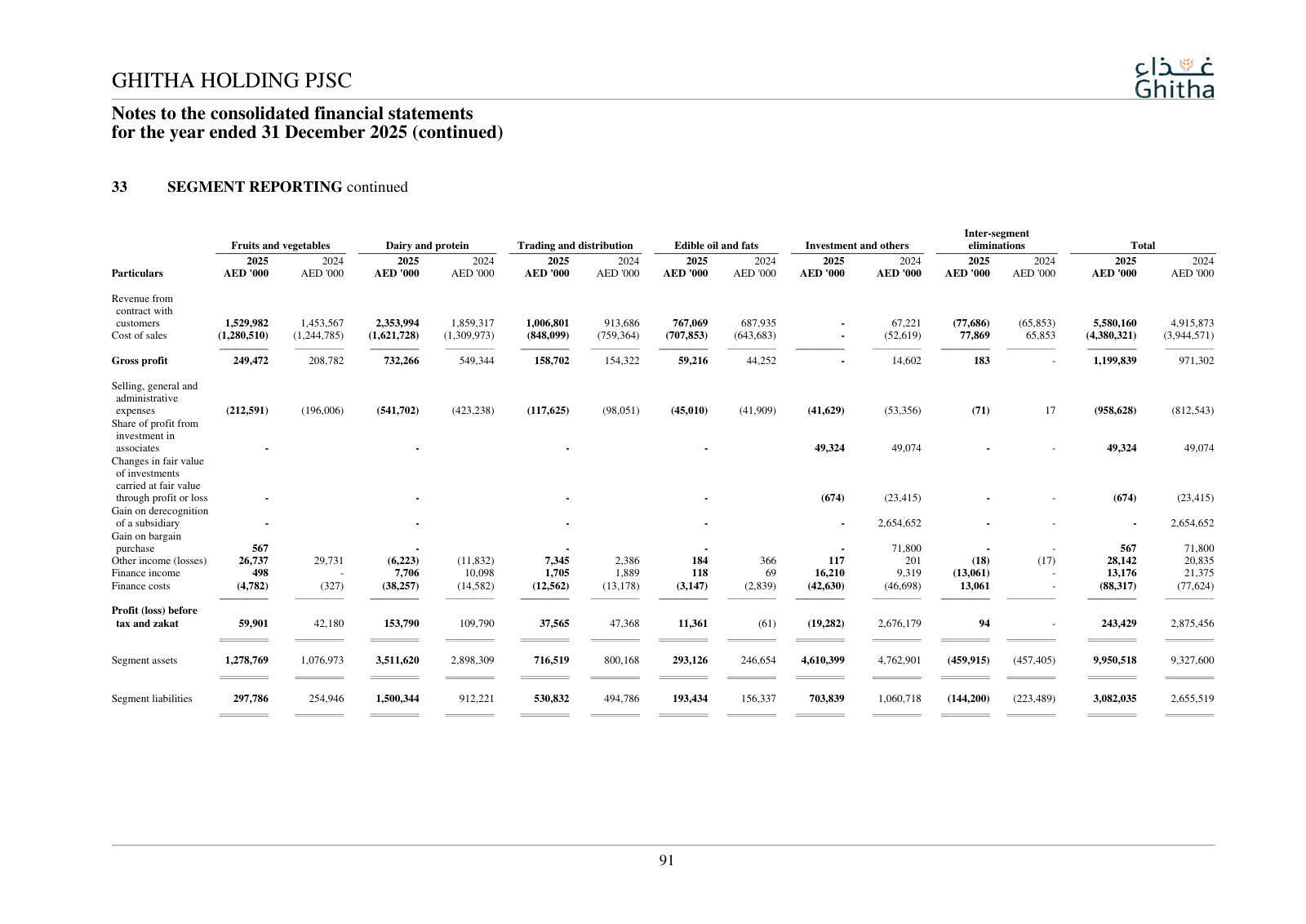
How the money is actually made — five segments, with dairy & protein now the largest revenue and profit pool.
The five reportable segments the CEO manages the group by.
The Group is organised into five reportable segments namely, fruits and vegetables, dairy and protein, trading and distributions, edible oil and fats and, investments and others.
p. 92 · Read in context →
Note 34 — Financial Risk Management — p. 94 · Read the full section →
The leverage and market-risk picture behind the growth — net debt of AED 2.24bn against equity, plus currency, interest-rate and credit exposures.
Capital is managed to gearing; 2025 net debt/equity was 0.29 (AED 2.24bn net debt), up from 0.26.
Consistent with others in the industry, the Group monitors capital on the basis of the gearing ratio. This ratio is calculated as net debt divided by total capital.
p. 94 · Read in context →
Zee Store PJSC — FY2020 Annual Report (Financial Statements) — FY2020
The 'before' snapshot: a single food-importer with AED 289m revenue that IPO'd in Dec 2020 — five years before it became a AED 5.58bn multi-segment group. · Open the full document →
Directors' Report — Principal Activities & Results — p. 3 · Read the full section →
Shows the original, narrow business — trading and importing packaged food — and a revenue base ~1/19th of today's.
In 2020 the whole company was a food importer/re-packager earning AED 289m — the starting point of the roll-up.
The principal activities of the Company include the trading and importing of fresh consumables, canned, preserved and frozen foods and providing re-packaging and wrapping services. […] Revenue for the year amounted to AED 289,029,171 (2019: AED 302,999,460) and profit for the year was AED 12,295,273 (2019: AED 18,636,453).
p. 3 · Read in context →
More annual reports
Ghitha Holding PJSC — FY2024 Annual Report (Consolidated Financial Statements) — FY2024 · 83 pages · The year of the AED 2.65bn one-off gain on derecognising Apex Investment — the spike that makes 2025's profit look like a collapse. · Open →
Ghitha Holding PJSC — FY2023 Annual Report (Consolidated Financial Statements) — FY2023 · 83 pages · Early build-out year — documents the NRTC and Al Ain Farms combinations that assembled the current segment mix. · Open →
Ghitha Holding PJSC — FY2022 Annual Report (Consolidated Financial Statements) — FY2022 · 83 pages · First consolidated year post-rename to Ghitha: revenue leapt to AED 2.28bn from AED 546m as subsidiaries were folded in. · Open →
Competitors describe Ghitha Holding P.J.S.C's market in their own filings and calls. These verified passages and visual pages show where their strategies meet, using source documents preserved in Sources.
Agthia Group PJSC (AGTHIA)
Agthia is Ghitha's most direct listed peer: an Abu Dhabi-based, IHC-adjacent food & beverage group whose UAE portfolio — bottled water, flour, animal feed, protein/poultry and snacking — overlaps Ghitha's food import, distribution and protein businesses, and which is pursuing the same GCC/MENA roll-up strategy.
Agthia's stated FY2025 read on its home UAE market: Al Ain claiming bottled-water category leadership at a 30.8% value share, and food revenue rising on new UAE local distribution agreements — the same water and food-distribution arena Ghitha operates in.
Al Ain bottled water retaining its market leadership position (YTD value share +1.9pts to 30.8% […] Food revenue +31.9% YoY in FY’25 on heels of new UAE local distribution agreements
p. 30 · Read in context →
Agthia describes an aggressive protein build-out — combined KSA protein sales up 41.1% and a second Saudi facility adding ~5,500 tons/annum in 2026 — expanding the value-added meat/poultry capacity that competes with Ghitha's protein operations.
Combined KSA protein sales, including Nabil export volumes, grew 41.1% YoY in FY’25, underscoring our strengthened market presence and expanding production capabilities in the region. […] Phase 2 of KSA facility to launch in early 2026 with additional capacity ≈ 5,500 tons/annum.
p. 28 · Read in context →
Agthia's three strategic pillars frame growth around M&A-led expansion — mirroring Ghitha's own acquisition-driven, IHC-backed build-out of a regional food platform.
Pursue disciplined expansion plan focused on M&A […] Protect the core business and get leaner […] Ensure our organization is set-up to deliver our strategy
p. 5 · Read in context →
Hily Holding PJSC (formerly Foodco Holding) (FOODCO)
Hily, the former Foodco Holding, is another Abu Dhabi investment holding company whose group imports and distributes foodstuff in the UAE and runs foodstuff wholesale and catering subsidiaries — the local food import/distribution niche at the core of Ghitha's business.
Hily's board report defines the group as a securities/real-estate holding company that is 'also engaged in the importing and distribution of foodstuff and household items in the United Arab Emirates' — a holding-company-plus-food-distribution structure that parallels Ghitha's own.
The principal activity of the Company and its subsidiaries (together, the “Group”) is primarily the management of securities portfolios, along with investing, development and management of real estate and commercial enterprises. The Group is also engaged in the importing and distribution of foodstuff and household items in the United Arab Emirates.
p. 3 · Read in context →
Hily discloses capex to expand a warehouse in Al Mafraq (Abu Dhabi) — the kind of food-distribution infrastructure investment that underpins competition with Ghitha's trading and logistics footprint.
The Group is expanding one of its warehouses in Al Mafraq and has engaged an external contractor for the same. The expansion is expected to be substantially completed by July 2025.
p. 56 · Read in context →
Savola Group (2050)
Savola is the GCC's largest integrated food platform (edible oils, sugar, pasta, frozen food and Panda retail), and its edible-oil and staple-food businesses across Arabia directly overlap Ghitha's edible-oils and food-trading operations.
Savola's account of its edible-oil business — a volume-led FY2025 despite 'continued competitive pressures' — sizes the intensity of the edible-oils category Ghitha also trades in.
Savola Foods Edible oil business delivered a stronger FY 2025 performance, primarily driven by increased volumes and higher commodity prices in the edible oil category despite continued competitive pressures
p. 12 · Read in context →
Savola's self-description as one of the region's most integrated food platforms — manufacturing, supply chain and retail access — illustrates the vertically integrated scale a food holding like Ghitha is competing against.
Savola today operates one of the region’s most integrated food platforms, serving millions of consumers through manufacturing scale, supply chain capabilities, and retail access
p. 5 · Read in context →
Saudia Dairy & Foodstuff Company (SADAFCO) (2270)
SADAFCO is the GCC's leading dairy and packaged-foodstuff player (Saudia UHT milk, tomato paste, ice cream) that is extending its distribution reach into the wider GCC including the UAE — overlapping Ghitha's dairy and foodstuff distribution.
SADAFCO's stated category shares — roughly half of Saudi UHT milk and tomato paste — quantify the entrenched dairy/foodstuff leadership Ghitha's dairy business competes against in the region.
Market Share (MAT^) in Dec’25 remained firm for UHT Milk (Plain + Flavored), Tomato Paste and Ice Cream at 50.5%, 51.3% and 30.5% respectively
p. 3 · Read in context →
SADAFCO attributes its sustained leadership to continued spending on selling and distribution — the distribution moat that is the direct competitive front against a distributor like Ghitha.
Continued investments in Selling & Distribution have supported growth and sustained market leadership (MAT Dec’25): UHT Milk (Plain + Flavored) 50.5%, Tomato Paste 51.3% & Ice cream 30.5%
p. 13 · Read in context →
National Agricultural Development Company (NADEC) (6010)
NADEC is a Saudi agri-food group spanning dairy, protein/meat, poultry, greenhouses and seed production (NSPC) — the same food-security verticals (dairy, poultry, aquaculture, agriculture) that Ghitha is assembling.
NADEC signals a move into value-added meat via a slaughterhouse joint venture (Hilton) — a protein-processing push that collides with Ghitha's poultry and protein ambitions.
MOU signed and joint business planning underway to introduce a value-added meat product range.
p. 8 · Read in context →
More peer documents
Agthia Group — Q1 FY2026 earnings presentation — 39 pages · Page 31's 'Market Leading Brands' table ranks Agthia #1 in the UAE for Flour B2B (47.0%), Animal Feed B2B (44.7%) and Bottled Water (32.7%) — hard share numbers across categories Ghitha touches. · Open →
Agthia Group — FY2025 consolidated financial statements — 64 pages · Segment revenue and geographic disclosures size Agthia's water, protein, agri-business and snacking arms for a fuller read on the UAE competitor's scale. · Open →
Savola Group — Q3 FY2025 earnings presentation — 30 pages · Reiterates the edible-oil volume story and claims Panda is the Kingdom's largest modern-trade retailer, showing Savola's manufacturing-to-retail integration. · Open →
SADAFCO — Q1 FY2026 earnings presentation — 14 pages · Latest MAT (Feb'26) category shares and emerging-channel momentum; also names the Panda/Savola retail ecosystem SADAFCO partners with. · Open →
SADAFCO — Q3 FY2025 earnings presentation — 14 pages · Shows an even higher UHT-milk share (57.7% MAT Sep'25), underlining how dominant the incumbent dairy/foodstuff distributor is. · Open →
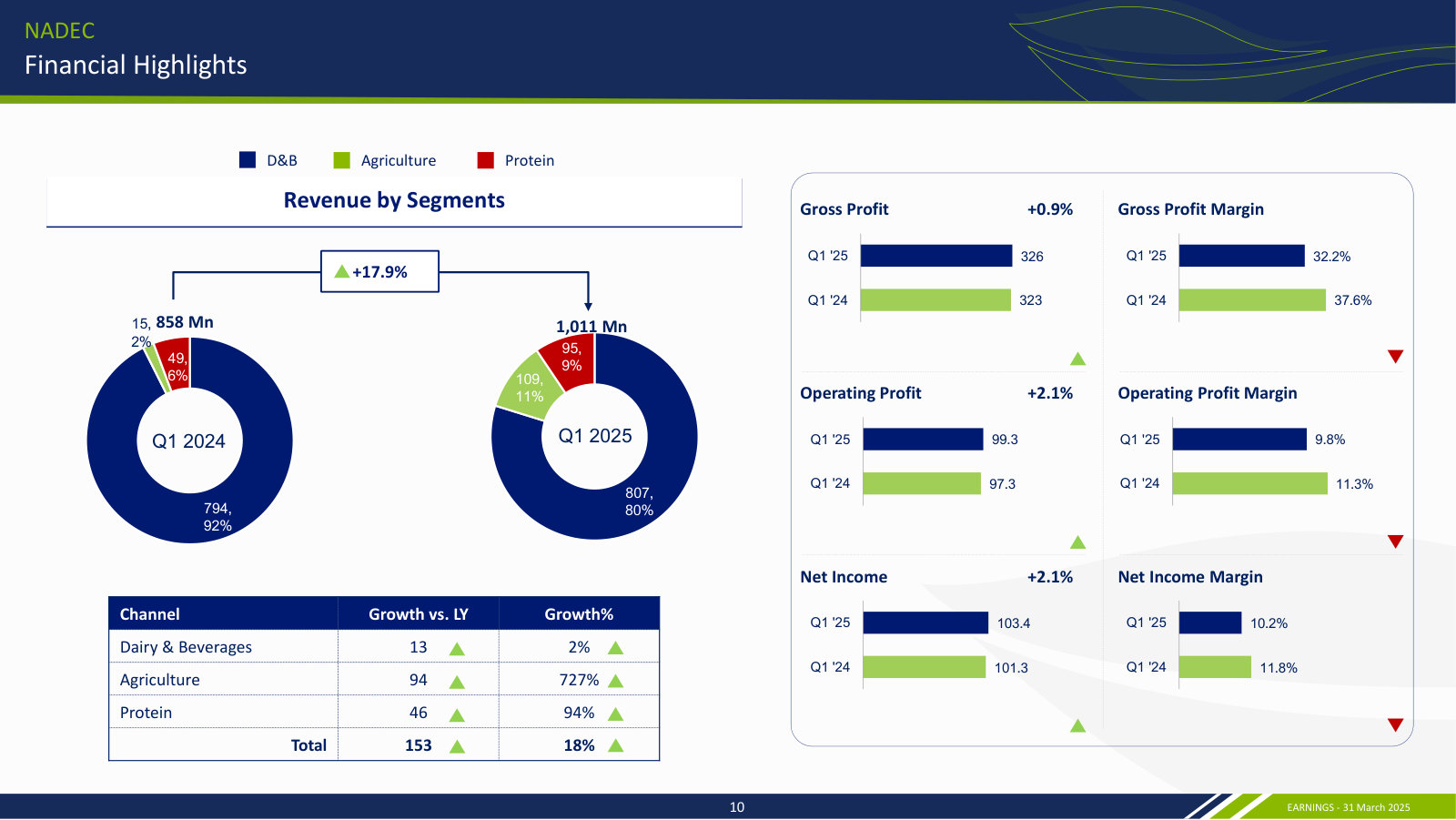
NADEC — Q3 & 9M FY2025 update — 20 pages · Segment tables show Protein and Agriculture revenue surging, plus NADEC's 2024 Sustainability/ESG report framing its food-security role. · Open →
Almarai Company — income statement (financials only) — 1 page · Almarai is the largest vertically integrated GCC dairy/juice/bakery/poultry producer and a core regional competitor, but only standardized financial statements (no narrative filing or transcript) are available here, so it could not be featured with an exhibit. · Open →
Scale and Book Value
Ghitha Holding is an Abu Dhabi food-and-agriculture holding company assembled by acquisition inside the IHC / Royal Group orbit, renamed from Zee Store in 2022 and now controlled by Two Point Zero Group. FY2025 revenue reached AED 5.58bn, roughly nineteen times its 2020 level, yet the shares trade near half of the AED 5.45bn equity attributable to owners. Most of that book is not the food business; it is a marked-to-market stake in a listed affiliate.
What the company is
Ghitha Holding P.J.S.C is a private joint-stock company incorporated in Abu Dhabi, with ordinary shares listed on the Abu Dhabi Securities Exchange [1]. It began life as Zee Store PJSC, a food retail-and-wholesale business, and adopted the Ghitha name in 2022 [2]. It reached the market by direct listing on the ADX Second Market in December 2020 rather than through a public offering, and has since grown into a vertically integrated portfolio spanning dairy, poultry, aquaculture, fresh produce, edible oils, and food trading — including Al Ain Farms, Marmum Dairy, Al Jazira Poultry, Asmak, NRTC and Zee Stores [3].
Control has always sat with the Abu Dhabi conglomerate ecosystem. At the 2020 listing, International Holding Company (IHC) was the parent and Royal Group Holding the ultimate parent [4]. During 2025 that changed hands within the same group: IHC Food Holding transferred its entire shareholding to Two Point Zero Group (formerly Multiply Group), which became the parent effective 30 November 2025 [5]. Ghitha is a controlled subsidiary throughout; the public float trades alongside a parent that directs the portfolio. There is no sell-side analyst coverage and the company holds no earnings calls.
How big, and how fast it got there
The scale is recent and acquisition-driven. Revenue ran at roughly AED 0.3bn in 2019–2020 as a single-line consumer-goods trader; it then multiplied as the group consolidated acquired food and agriculture businesses.
Sources: FY2020 revenue AED 289.0m and FY2019 AED 303.0m [6]; FY2021 AED 545.6m and FY2022 AED 2,278.6m [7]; FY2023 AED 4,566.9m [8]; FY2024 AED 4,915.9m and FY2025 AED 5,580.2m [9].
The business is a food group first. FY2025 revenue splits across five reported segments, and the profit is far more concentrated than the sales: dairy and protein produced 42% of revenue but 61% of gross profit, at a 31% gross margin, while the low-margin trading, produce and edible-oil lines carry the volume [10].
Source: FY2025 Annual Report, Segment Reporting — segment revenue and gross profit [11]; segment definitions [12].
Food distribution is a thin-margin trade, and Ghitha is no exception. Group gross margin was 21.5% in FY2025 and operating margin 5.7%; after non-controlling interests, finance costs and loss-making disposals, the profit attributable to owners was AED 36.5m — a 0.7% net margin on AED 5.58bn of sales [13].
FY2025 Revenue (AED bn)
Operating Margin
Net Margin to Owners
FY2025 Profit to Minorities
Source: derived from FY2025 Annual Report, Consolidated Statement of Profit or Loss — revenue AED 5,580.2m, operating profit AED 318.7m, profit to owners AED 36.5m of AED 89.9m group profit [14].
The reported profit does not mean what it looks like
Headline earnings are the least reliable number in this company. Profit attributable to owners was AED 30.3m in FY2023, then AED 2,556.1m in FY2024, then AED 36.5m in FY2025 [15] [16]. The FY2024 figure is not operating income.
Sources: FY2021 AED 57.6m and FY2022 AED 281.7m [17]; FY2023 AED 30.3m [18]; FY2024 AED 2,556.1m and FY2025 AED 36.5m [19].
The FY2024 spike came from a single accounting event. In January 2024 the group sold a 3% stake in a listed associate, Apex Investment PSC, for AED 213.2m cash, lost control, and remeasured its retained 48.5% holding to Apex's quoted market price of AED 3,446.9m. That step produced a gain on derecognition of AED 2,654.7m — essentially all of FY2024's reported profit, and almost none of it cash [20]. Strip the one-off out and the cleaner read is operating profit, which rose from AED 254.4m in FY2023 [21] to AED 318.7m in FY2025 as gross margin widened toward the higher-margin dairy mix [22]. The underlying operating trajectory is up; the earnings line is noise until the one-offs are removed.
The book, the price, and where value actually sits
The relationship between market price and book value is where the report's analysis concentrates. At AED 11.30 per share and 241.6m shares, Ghitha's market capitalisation is roughly AED 2.73bn — about half the AED 5.45bn of equity attributable to owners [23]. A holding company trading at half of book is the kind of asset that warrants scrutiny rather than celebration, and the composition of that book is what the rest of the report examines.
Market Cap (AED bn)
Equity to Owners (AED bn)
Price / Book (owners)
Associates as % of Book
Source: equity attributable to owners AED 5,454.4m and investment in associates AED 4,141.6m per FY2025 Annual Report, Statement of Financial Position [24]; market capitalisation derived from the ADX closing price of AED 11.30 (31 July 2026) and 241.6m shares outstanding.
Three-quarters of the owners' book is not the food group. Investment in associates stood at AED 4,141.6m at end-2025 — 76% of the AED 5.45bn equity attributable to owners — dominated by the same Apex stake, carried by the equity method after the 2024 remeasurement [25]. The operating food-and-agriculture businesses — property, plant and equipment of AED 2,159.5m, goodwill and intangibles of AED 611.4m, biological assets, inventory and receivables, against AED 1,146.8m of bank borrowings — net to a far smaller slice of the owners' equity [26] [27].
Source: derived from FY2025 Annual Report, Statement of Financial Position — associates AED 4,141.6m; balance to reconcile with equity to owners of AED 5,454.4m [28].
That composition cuts both ways, which is the point. The associate is a listed security with an observable price, so a large part of the stated net worth is at least marked to a real market rather than to management's estimate — a point in favour of the discount being genuine. Against it: a minority Ghitha shareholder holds an indirect, minority interest in that affiliate through a parent-controlled holding, the equity-method income it throws off is modest (AED 49.3m in FY2025, larger than the whole group's profit to owners), and the food businesses beneath it convert little of their revenue into owner earnings [29]. What would settle the question is evidence on two fronts: whether the associate and goodwill carrying values hold up on scrutiny, and whether a controlled structure lets that value reach the public shareholder at all.
The through-line
That is the spine this report is built on: is Ghitha's discount to book a genuine margin of safety, or a fair price for a parent-assembled holding whose stated net worth is mostly a marked-to-market stake in a listed affiliate, and whose operating profits reach minority owners only after non-controlling interests, finance costs and loss-making disposals take their share? Everything that follows — the year-by-year financials and the absence of any forward estimates, the quality of the associate and acquisition accounting, the control and related-party structure, the operating economics of the food segments, and the valuation math — is an attempt to answer it on the evidence.
The Financial Record
Ghitha's three-year record is that of a fast-growing, cash-generative food group whose reported profit is small and, in one year, badly distorted. Revenue reached AED 5.58bn in FY2025; operating profit was AED 318.7m. The business threw off AED 425.9m of operating cash and AED 307.0m of free cash. Leverage is low — net bank debt of about AED 592m is roughly 1x EBITDA against AED 6.87bn of equity. No sell-side analyst covers the stock, so forward estimates do not exist.
All figures are in dirhams (AED). The dirham has been pegged to the US dollar at AED 3.6725 since 1997, so the currency risk in these numbers is, for practical purposes, minimal; FY2025 revenue of AED 5.58bn is about US$1.52bn.
Growth is real; reported profit is not the whole story
Revenue has compounded at roughly 35% a year over three years, the product of an acquisition-led build-out from a single-line consumer-goods trader into a five-segment food group. FY2025 revenue rose 13.5% to AED 5,580.2m, and operating profit rose 39.4% to AED 318.7m after a dip in FY2024 [1].
Source: revenue and operating profit as reported, FY2021–FY2025 consolidated statements; FY2025 and FY2024 from the FY2025 Annual Report [2].
The headline that a casual screen would flag — earnings per share of 10.58 in FY2024 collapsing to 0.15 in FY2025 — is an accounting artefact, not a business collapse. FY2024 profit was dominated by a AED 2,654.7m non-cash gain on losing control of the listed associate Apex; strip it out and the underlying operating line actually improved into FY2025. That distortion, and what it means for stated book value, is the subject of Scale and Book Value; here the point is narrower: operating profit, not net profit, is the read to track, and on that measure the trend is up.
Source: FY2025 Annual Report, Consolidated Statement of Profit or Loss (FY2024–FY2025) [3]; FY2023 comparatives from the FY2023 Annual Report [4].
Operating margin has held in a narrow band — 5.6% in FY2023, 4.7% in FY2024, 5.7% in FY2025 — consistent with a food-distribution-led model where volume, not pricing power, drives the P&L. Gross margin firmed from 19.8% to 21.5% between FY2024 and FY2025 as higher-margin dairy and protein grew into a larger share of the mix.
Cash generation: AED 307m of free cash flow
For a business whose accounting profit is thin, the cash statement is where the quality shows. Operating cash flow has been solidly positive every year, and free cash flow has risen for three straight years to AED 307.0m in FY2025 [5]. Free cash flow of AED 307.0m is 8.4x the AED 36.5m that reached owners on the P&L — the gap is the non-cash weight of depreciation (AED 277m across property, biological assets and leases), the equity-accounted associate, and the loss from discontinued operations, none of which drain cash in the year.
Source: FY2025 Annual Report, Consolidated Statement of Cash Flows (FY2024–FY2025) [6]; FY2023 from the FY2023 Annual Report [7].
One nuance worth carrying forward: the FY2023 cash figure benefited from a lighter working-capital year, and capital spending that year (AED 450.4m) was three to four times the FY2024–FY2025 run-rate of about AED 115m–AED 119m, reflecting a capacity build that has since normalised [8]. A mild watch item sits inside FY2025: trade receivables grew 26% (to AED 1,207.2m) against 13.5% revenue growth, a faster build than sales; operating cash flow still absorbed it, helped by AED 186m collected from related parties [9].
The balance sheet: modestly geared, well short of distress
For a reader whose first test is whether the company can go bankrupt, the leverage is modest: net bank debt of about AED 592m is roughly 1x EBITDA against a AED 6.87bn equity base. Total assets stand at AED 9,950.5m [10] against AED 3,082.0m of total liabilities [11]. Interest-bearing bank borrowings total AED 1,146.8m [12] and cash is AED 555.1m [13], for net bank debt of about AED 592m.
Total Assets (AED m)
Total Equity (AED m)
Net Bank Debt (AED m)
Current Ratio
Source: FY2025 Annual Report, Consolidated Statement of Financial Position [14] [15].
That net debt is about 1x EBITDA (operating profit plus roughly AED 277m of depreciation). Even adding the AED 205m of loans from related parties and AED 183m of lease liabilities, gross-of-cash obligations sit near 1.6x EBITDA, and net debt is under 15% of the AED 6.87bn equity base. Current assets of AED 2,506.1m cover current liabilities of AED 1,798.0m at 1.39x. The company's own capital-management note uses a broader definition — folding trade payables and related-party balances into "net debt" — and still reports gearing of 0.26 in FY2024, down from 0.36 in FY2023 [16].
The direction of travel is worth noting even so. FY2023 closed in a net-cash position (AED 1,004.7m cash against AED 959.4m of bank borrowings); by FY2025 the group carried net bank debt of about AED 592m, as acquisitions and capacity absorbed the cash [17]. This is a company adding modest leverage from a very conservative base, not one stretching a balance sheet.
The larger feature of the balance sheet is where equity came from. Owners' equity nearly doubled in FY2024 — from AED 2,736.2m to AED 5,321.4m — with most of the increase supplied by the one-off Apex remeasurement rather than retained trading profit [18].
Source: FY2025 Annual Report [19]; FY2023 from the FY2024 Annual Report, Note 34 [20].
What actually reaches a minority owner
Two things stand between operating profit and the profit a public shareholder can claim, and both are material. Finance costs (AED 88.3m) and tax (AED 30.8m) take their share; then a loss from discontinued operations of AED 122.7m — a business the group is exiting, which also lost AED 188.1m in FY2024 — pulls the total down to AED 89.9m. Of that, non-controlling interests take AED 53.4m, leaving AED 36.5m, or 41% of group profit, for the owners of the parent [21].
Source: FY2025 Annual Report, Consolidated Statement of Profit or Loss [22]. Net finance and other combines finance income, finance costs, fair-value moves and acquisition gains.
The minority-interest leakage is structural, not a one-year event: non-controlling interests hold AED 1,414.0m of the AED 6,868.5m total equity, so a fifth of the consolidated balance sheet belongs to partners in subsidiaries rather than to public shareholders [23]. The discontinued-operations drag, by contrast, should fade as the exit completes; the assets held for sale (AED 115.6m) and their associated liabilities (AED 138.9m) are already carved out on the balance sheet [24].
Forward estimates: none exist
The investor's checklist calls for two or more years of forward estimates. For Ghitha, they cannot be supplied, and the absence is itself the finding: the stock is covered by zero sell-side analysts, so there is no consensus revenue, earnings or price-target series from any aggregator. The only public forward number is a third-party quantitative model's fair-value estimate, which is not analyst work and should not be read as consensus. Any forward view on this company has to be built from the primary record, not inherited from the street.
That neglect is consistent with the price action. Having opened 2026 near AED 16.90 after the FY2025 results, the shares fell to AED 11.30 by end-July — down about a third, and near the AED 10.22 low of the trailing range. At AED 11.30 the shares have fallen about a third while reported EPS fell 98.6%, so the price implies a valuation set against book and normalised earnings rather than the distorted FY2025 headline. Whether that is a fair mark on a minority-diluted, parent-controlled holding is what the rest of the report examines.
No sell-side analyst covers Ghitha, so no forward consensus estimates exist. Forward analysis must be built from the filings.
Share-price data as reported; coverage status per public aggregators (Simply Wall St, Investing.com), which show zero analyst estimates for GHITHA.
The Apex Stake
Three-quarters of Ghitha's book value is one associate stake — the holding in ADX-listed Apex Investment PSC — so that line largely determines whether the discount to book is a margin of safety. One transaction has tested the carried mark against a live market price, and it reads two ways at once. In March 2026 Ghitha sold 1.7% of Apex at its quoted price for AED 204,783 thousand against a carrying value of AED 119,403 thousand, implying the retained 46.8% is worth about AED 5.6bn versus AED 3.3bn carried, so the stock trades near 0.35x a look-through net asset value; yet that consideration settled AED 205m of related-party loans rather than paying cash to the minority float. [1]
The surplus is large. About AED 2.35bn sits above the carried value — roughly 43% of the AED 5,454.4m equity attributable to owners — and it lifts look-through net asset value to AED 32.30 a share, about 2.86x the AED 11.30 share price. The float owns that gap on paper but cannot itself convert it to cash: the only monetisation so far transferred shares to a related party to extinguish loans. The mark is also the book's most sensitive point, because it turns on a single ADX quote in the parent's orbit and the equity method carries no unrealised gain — a sustained fall in that quote flows into an impairment rather than merely erasing the surplus.
Reported Book / Share (AED)
Look-Through NAV / Share (AED)
Share Price (AED)
Price / Look-Through NAV
Source: derived from FY2025 owners' equity and share count [2] and the March-2026 Apex sale price [3].
Where the book value sits
Ghitha's balance sheet does not look like a food company's. Of AED 5,454.4m equity attributable to owners, AED 4,141.6m — 76% — is a single line: investment in associates [4]. The operating assets a reader would expect to underpin the book — property, plant and equipment of AED 2,159.5m — are real, but they are largely financed by liabilities and non-controlling interests; the equity that public shareholders own is dominated by the associate stake [5].
Investment in Associates (AED m)
Share of Owners' Equity
Goodwill & Intangibles (AED m)
Source: FY2025 Annual Report, Consolidated Statement of Financial Position [6].
The associate line is chiefly one entity: Apex Investment PSC, an Abu Dhabi holding company listed on the ADX (ticker APEX, formerly Ras Al Khaimah Cement, renamed in 2022). Ghitha held 48.5% at the year-end, alongside two much smaller associates — Invictus Investment Company PLC (22.32%) and Anina Culinary Art (45%) [7]. The stake became an associate on 30 January 2024, when Ghitha sold 3% of Apex, lost majority board control, and moved the holding off the consolidated accounts and onto the equity method (the event that produced the FY2024 headline gain covered in Scale and Book Value) [8].
What the AED 4.14bn is made of
The filing quietly discloses how little of the carrying value is backed by the associates' own net assets. Ghitha's share of the associates' net assets is AED 1,379.8m; the amount carried on the balance sheet is AED 4,141.6m [9]. The AED 2,761.7m gap is goodwill and intangibles embedded inside the equity-method line — value that exists only if Apex's earning power and market price justify a premium of roughly three times its underlying book.
Source: FY2025 Annual Report, Note 16 — Group's share of net assets vs carrying amount [10].
That premium was struck once, in January 2024, and has barely moved since. When Ghitha lost control, it recorded the retained 48.5% at AED 3,446.9m — a figure calculated "with reference to the quoted price of the shares of Apex on the date of disposal" [11]. Under the equity method the carrying value is not remarked to Apex's live share price afterwards; it moves only by Ghitha's share of associate profit, less dividends. So the balance rose from AED 4,098.7m at the end of 2024 to AED 4,141.6m at end-2025 — a drift of AED 42.9m against a AED 4.1bn base [12].
Source: FY2025 Annual Report, Notes 16 and 6.7 [13] [14].
The practical consequence: the reported book neither confirms nor denies that Apex is still worth AED 4.1bn. The number is anchored to a January-2024 quote and then carried forward on accrual accounting. Ghitha does not disclose the year-end market value of the listed stake in its annual report, so between transactions an investor cannot see the mark move.
The market test
The March-2026 disposal is the only point at which Apex's market price surfaces inside Ghitha's own accounts, and it prices the retained stake well above its carried amount. Scaled up, that price implies Apex is worth roughly AED 12.0bn in whole, and the retained 46.8% about AED 5.6bn — against the AED 3.3bn at which the stake is carried. On the only observable market price, the Apex holding carries at about 0.6x its value: a surplus of roughly AED 2.35bn sits outside the AED 5,454.4m book.
Source: carrying value derived from the FY2025 Note 16 balance and the March-2026 disposal ratio; market value from the H1 FY2026 disposal at Apex's quoted price [15].
On a look-through basis the discount is deeper than the ~0.5x reported book established in Scale and Book Value, because the market value of Apex is not yet reflected in the balance sheet. For an investor buying assets below a high net asset value, this is the constructive read: the dominant asset is a listed security carried below its last observable market price, not a management estimate that could be quietly written down.
What makes the mark fragile
The same facts carry the counter-case, and it is not small. The Apex quote that sets the mark is a demanding one. At an implied AED 12.0bn, Apex trades at about 46x its AED 262.8m associate-level profit and 3.3x its own AED 3,624.0m equity [16]. Apex sits in the same Abu Dhabi ownership orbit as Ghitha — the IHC / Two Point Zero group — where listed vehicles carry elevated multiples on thin free floats. A quote struck in that setting can move a long way without a change in the underlying business, and Ghitha's book would follow it in only one direction quickly: down, through an impairment test, since the equity method does not carry unrealised gains.
Three further frictions sit between the mark and a minority shareholder:
The value that has been realised was not paid to public holders. The March-2026 disposal settled loans from related parties, not an open-market sale for cash — Apex shares were transferred to extinguish AED 205.0m of related-party borrowings [17], [18].
Ghitha holds influence, not control — 46.8% and two of Apex's five board seats [19]. It cannot compel a sale or a distribution.
The cash the stake actually yields is trivial. Dividends received from all associates were AED 7.4m in FY2025 against a AED 49.3m equity-accounted share of profit [20]. Most of the reported "earnings" from Apex are not collectible in cash without selling shares.
The stake's value is therefore real on paper and, so far, has been converted at that value — but through the parent-directed machinery of related-party settlement rather than into cash for the float.
The rest of the soft book
Beyond Apex, the assets that carry above their tangible substance are modest and conventional. Goodwill and other intangibles total AED 611.4m — including AED 256.7m of goodwill and AED 224.3m of customer relationships, most of it added through FY2025 acquisitions [21]. Management ran its annual discounted-cash-flow impairment review in Q4 2025 and concluded recoverable amounts exceeded carrying values, so no impairment was taken [22]. Biological assets — dairy cows, camels and poultry — are carried at AED 235.2m and fair-valued each period, a genuine but small operating asset [23].
The one associate that has been tested against a real exit was written down. When Ghitha moved to sell Anina Culinary Art in H1 2026, it measured the holding at fair value less costs to sell and booked a AED 25.9m impairment [24]. Anina is tiny relative to Apex, but it shows the direction impairment runs when an equity-method holding meets a disposal test: an equity-method carrying value is confirmed only when the holding is actually sold.
What would change the read
The margin of safety here is asset-based and quote-dependent, so the facts that would move it are specific and checkable:
- Apex's ADX share price. A sustained fall below the equity-method carrying value (roughly AED 3.3bn for 46.8%, about AED 70m of carrying value per 1% held) would force an impairment test and could turn the hidden surplus into a hidden shortfall.
- A cash, third-party sale of Apex shares. Any disposal to an unrelated buyer for cash — rather than related-party loan settlement — would validate the mark and route value to the balance sheet the float owns.
- A year-end fair-value disclosure of the listed stake. Its continued absence leaves shareholders reliant on occasional transactions to see the mark; its appearance would close the gap.
- Goodwill and customer-relationship impairments at the next annual review, which would signal that the FY2025 acquisitions are underperforming the cash flows used to justify them.
On the evidence, the book is struck conservatively against the only market price available, and the discount to a look-through NAV is real. It holds on two conditions: that a richly-valued, thinly-floated ADX security in the parent's orbit is worth what it last traded at, and that a minority holder can eventually see that value in cash rather than in the parent's deleveraging.
Control and Ownership
Ghitha is controlled at two levels, and both work against the listed float. Its parent group holds roughly 84% of the shares, leaving a public float near 16%. And Ghitha itself consolidates its two largest food businesses — Al Ain Farms and NRTC — through board-control agreements while owning under half of each. The economics the float actually owns are thinner than reported book implies, and cash and value move through related-party channels rather than through distributions to minorities.
Parent group stake
Public free float
Minority interest in equity
Key mgmt + board pay (AED m)
Parent stake and free float derived from the November 2025 share-swap disclosures (see below); minority interest and pay from the FY2025 Annual Report [1] [2].
The parent holds about 84%; the float is thin
For most of its listed life Ghitha sat inside International Holding Company (IHC): IHC Food Holding LLC was the direct parent and Royal Group the ultimate parent at the December 2020 listing. That changed in late 2025. IHC Food Holding transferred its entire shareholding to Two Point Zero Group PJSC (formerly Multiply Group) in an extraordinary general meeting, and Two Point Zero became the parent effective 30 November 2025 [3].
The reorganisation is instructive for a minority holder. In the share swap, Multiply issued about 1.77 billion new Multiply shares to acquire the Ghitha stakes held by IHC Food Holding and IHC Companies Management — a block reported at roughly 83.9% of Ghitha, folded into a combined entity valued near AED 120 billion. The public float — the remaining ~16% — was not tendered or bought out. The controlling block reorganised itself one level up while the float stayed in the same listed vehicle, now under a different parent. At AED 11.30 that float is worth only about AED 440m, against a AED 2.73bn market capitalisation on 241.6 million shares [4].
Board control mirrors the ownership. Of five directors, the Chairman is also Vice Chairman of IHC and another member is IHC's Group Chief Financial Officer; the Group CEO sits on the board as an executive. Chairman and CEO are separate people, but the board is populated from the controlling group's own ranks, and the standalone corporate-governance report is not machine-readable, so the independent-director count is not verifiable from an accessible filing.
The parent-level share swap moved roughly 84% of Ghitha from IHC to Two Point Zero/Multiply without any offer to the ~16% public float, which remains in the listed entity.
Control without ownership: the two biggest businesses
The more distinctive feature is one level down. Ghitha consolidates its two largest operating businesses without owning a majority of either, and says so plainly. It "considers that it has a controlling interest over NRTC Food Holding LLC through a contractual arrangement, even though it owns less than 50% of the voting rights", having appointed three of NRTC's five board seats under a shareholders' agreement; it claims the same "de facto control" over Al Ain Farms with four of seven seats [5]. Economic ownership is 41% of NRTC (fruit and vegetables) and 48.3% of Al Ain Farms (dairy, poultry and livestock) [6] [7].
This is legitimate under IFRS 10, and it is why the group can present a AED 5.6bn revenue base. But it means the food business the reader is being asked to value is substantially owned by outside partners. Minority interests hold AED 1,414.0m — about 21% of total equity [8] — and Al Ain Farms alone accounts for AED 976.5m of the AED 1,453.9m sitting in the material partly-owned subsidiaries [9]. The leakage to minorities that Three-Year Financials quantified at the group line is not an accident of one weak year; it is built into how the group is assembled.
Source: FY2025 Annual Report, Note 3 basis of consolidation and Note 31 material partly-owned subsidiaries [10]. Board seats disclosed only where de facto control is claimed.
The cascade compounds. A public shareholder owns roughly 16% of a company that in turn owns 48.3% of Al Ain Farms — a look-through economic claim on the group's single most valuable food asset of under 8%. Nothing here is hidden or improper; it is disclosed clearly. But it is the reason reported book value and reported revenue overstate what the float economically owns.
Related-party plumbing
Ghitha does not operate at arm's length from its controlling orbit; it trades, borrows and lends inside it. In FY2025 the group booked AED 537.1m of revenue with related parties — close to a tenth of total sales — down from AED 638.4m a year earlier [11]. It carried AED 494.1m of borrowings and payables to a related-party financial institution and AED 229.9m of deposits and receivables at the same institution [12]. It owed AED 205.0m of loans to entities under common control — the same loans that The Apex Stake showed were settled not in cash but by handing over Apex shares [13].
Source: FY2025 Annual Report, Note 29 related party transactions and balances [14] [15].
One FY2025 entry is worth isolating. A related party under common control waived AED 76.5m owed to it, and the benefit went straight to reserves as an equity credit rather than through the income statement [16]. It is a genuine gain to the float, but it is the parent's gift to give — the same discretion that can move value out of the entity can move it in. For a NAV-based value case, this discretion runs both ways: the controlling group can route value into or out of the entity through waivers, related-party financing and share swaps, and the minority is a price-taker on each.
What the controllers cost
Key management and board remuneration was AED 28.6m in FY2025, down from AED 30.3m [17]. Measured against the business it runs — roughly AED 5.6bn of revenue and AED 318.7m of operating profit — that pay is about 9% of operating profit, unremarkable. Measured against what the float keeps, it looms larger: profit attributable to owners was AED 36.5m in FY2025 [18], so the running cost of the people directing the company equalled about four-fifths of the residual profit the public shareholders were left with.
Key mgmt + board pay (AED m)
As % of profit to owners
As % of operating profit
Source: FY2025 Annual Report — pay from Note 29 [19]; profit to owners and operating profit from the income statement [20].
Neither framing is the whole truth. Pay is modest for a group of this size and fell year on year, and the thin owners' profit is depressed by the minority and discontinued-operations drags rather than by pay. But both readings matter to the same reader: the controllers' cost is small relative to the enterprise and heavy relative to the sliver the float is left with.
What this means for the case, and what would change it
On the evidence, the discount to book that anchors this report is real but conditional. It is real because the assets — the Apex stake, the food businesses — are genuine and, on the marks available, carried conservatively. It is conditional because two layers of control stand between those assets and the public float — the parent's ~84% at the top, and board-control agreements over food businesses Ghitha owns less than half of — and because the group's own history shows value being moved by related-party waiver, related-party financing and parent-level share swap rather than by cash returned to minorities. A ~16% float has no lever to force realisation and was not invited into the most recent reorganisation.
The strongest fact the other way is that minorities have not, so far, been treated abusively: the FY2025 waiver added value to the float, the equity-method mark on Apex was struck below its later market test, and the group pays a dividend to non-controlling interests, implying distributions do flow. What would change the read, in either direction: a tender or buy-out offer to the public float (or its pointed absence) as the Multiply combination completes; any related-party transaction that transfers value out of the listed entity on non-market terms; and disclosure — or continued non-disclosure — of an independent-director majority and the terms of the NRTC and Al Ain Farms shareholders' agreements that the whole consolidation rests on.
The business behind the balance sheet
Earlier chapters valued Ghitha as a holding company — a discount to a book dominated by the Apex stake, gated by a controlling parent. This one asks whether the operating business underneath is any good. The answer is concentrated: dairy and protein earns gross margins near 31%, matching the listed Gulf dairy champions, and now supplies 61% of group gross profit while compounding revenue at about 27% a year on a genuine UAE food-security tailwind [1]. But the blended group still earns distributor economics, the dairy engine is only 48.3% owned, and its returns are compressing as it spends to expand.
Group Gross Margin
Group Operating Margin
Dairy Share of Gross Profit
Source: FY2025 Annual Report, Consolidated Statement of Profit or Loss [2] and Note 33 Segment Reporting [3].
Ghitha is a vertically integrated UAE food group. It reports across four operating segments — fruits and vegetables, dairy and protein, trading and distribution, and edible oil and fats — spanning farming, manufacturing, packaging and distribution, with a residual investments line [4]. The operating brands are the recognisable ones: Al Ain Farms and Marmum in dairy, Al Ajban and Al Jazira in poultry, Asmak in seafood, NRTC in fresh produce, and ADVOC in edible oils.
The tailwind behind that portfolio is real and policy-driven. The UAE's National Food Security Strategy targets the country becoming the world's most food-secure nation by 2051, and management frames its food-and-agriculture expansion explicitly against that agenda [5]. The company positions Al Ain Farms — the UAE's first dairy company, tracing to a 1981 farm of 200 animals — as national food infrastructure rather than a discretionary brand [6]. The audited filings themselves carry no management discussion or strategy narrative, so the tailwind is evidenced by the company's own statements and the segment growth, not by a discursive MD&A.
Where the margin lives
The four operating segments are not equal businesses. In FY2025 dairy and protein turned AED 2,354.0m of revenue into AED 732.3m of gross profit — a 31.1% gross margin. No other segment comes close: fruits and vegetables earned 16.3%, trading and distribution 15.8%, and edible oil and fats just 7.7% [7].
Source: FY2025 Annual Report, Note 33 Segment Reporting [8].
The consequence is a heavy concentration of quality. Dairy and protein is 42% of revenue but 61% of gross profit, and that share is rising — up from 56.6% a year earlier as the segment grew revenue 26.6% (AED 1,859.3m to AED 2,354.0m) and pre-tax profit 40% (AED 109.8m to AED 153.8m) [9]. The rest of the group is thin-margin trading: it moves volume — AED 3.2bn of revenue across produce, distribution and oils — for a blended 13% gross margin.
Source: FY2025 Annual Report, Note 33 Segment Reporting; segment revenue shown gross of AED 77.7m inter-segment eliminations [10].
This is the mechanism behind the group's blended 21.5% gross margin and 5.7% operating margin: one high-margin, fast-growing dairy business carried on top of a low-margin distribution base. The mix is shifting the right way — toward dairy — which is why gross margin rose from about 19.8% in FY2024. But the shift is slow, and the group's economics still look far more like a food distributor than a branded dairy producer.
Against the Gulf field
Placed beside its listed peers, Ghitha sits at the trading end of the Gulf food industry — not the branded-producer end. The three Saudi dairy pure-plays — SADAFCO, Almarai and NADEC — earn 30–33% gross margins and, critically, keep far more of it: operating margins of 11–14% and net margins of 11–16%, against Ghitha's group 5.7% and 1.6% [11].
Sources: FY2025 figures — Agthia audited P&L [12]; Ghitha per Note 33 and P&L [13]; Saudi peers (SADAFCO, Almarai, NADEC, Savola) per reported FY2025 financials. Ghitha's net margin and ROE are depressed by non-controlling interests and discontinued-operations losses (see Three-Year Financials); Savola's ROE reflects a reduced post-restructuring equity base.
Two comparisons carry the read. The first is the closest one: Agthia, an Abu Dhabi food-and-beverage group of near-identical scale (AED 4.85bn revenue) in the same IHC ecosystem, earns a 29.1% gross margin — well above Ghitha's 21.5% — yet lands at a 4.7% operating margin, below Ghitha's 5.7% [14]. Agthia's richer gross margin is spent on the selling and distribution cost of running consumer brands. That both UAE food conglomerates convert to roughly the same mid-single-digit operating margin, by different routes, suggests the thin operating economics are as much a feature of the UAE food market as of Ghitha specifically.
The second comparison is the ceiling. SADAFCO — a focused Gulf dairy and foodstuff distributor — earns a 27.4% return on equity on the same 31% gross margin Ghitha's dairy segment reaches. That contrast shows the dairy model can convert its gross margin into a high return on equity. Ghitha's dairy arm reaches the gross-margin bar; it does not yet reach the returns.
Al Ain Farms, 48.3% owned
The dairy engine is one asset: Al Ain Farms for Livestock Production. It generated AED 1,977.7m of revenue — about 35% of the group — and AED 146.0m of profit in FY2025, on AED 1,887.6m of equity [15]. Two facts about it shape the investment case.
First, Ghitha owns only 48.3% of it. Al Ain Farms is consolidated in full through de facto control — four of seven board seats — but the AED 976.5m of equity attributed to its non-controlling interest is the largest single block of the group's minority leakage, and the listed float's look-through claim on the group's highest-margin business is well under half [16] [17].
Second, it is being built, not harvested. Al Ain Farms produced AED 310.5m of operating cash flow in FY2025 but spent AED 544.3m on investing — a deliberate expansion outflow [18]. Two poultry-and-egg acquisitions drove it: Arabian Farms for AED 240.0m in January 2025 and Al Jazira Poultry for AED 255.0m in May 2025 [19].
Al Ain Farms Revenue (AED m)
Net Margin
Operating Cash (AED m)
Investing Outflow (AED m)
Source: FY2025 Annual Report, Note 31 material non-controlling interests, summarised financial information for Al Ain Farms [20] [21].
That build-out shows in returns. Al Ain Farms earned a 7.4% net margin and about a 7.7% return on its equity in FY2025 — respectable for a farming business mid-expansion, but well short of SADAFCO's 27% or Almarai's 12%, and it is spending ahead of those returns rather than banking them [22]. The optimistic read is that the poultry and egg acquisitions extend the one segment that already earns a real margin, into adjacent proteins the same distribution network can carry; the outcome is not yet in the numbers.
Moat and durability
The competitive advantage that shows up in the numbers is narrow and located precisely: the dairy and protein segment's 31% gross margin, and Al Ain Farms' position as heritage UAE dairy and poultry infrastructure that the company says supplies more than a third of national consumption in those categories [23]. Local production for national food security, behind established brands and a cold chain, is a defensible position that a new entrant cannot easily copy — and it is the part of Ghitha that behaves like the good Gulf dairy businesses.
Three things keep that read from widening to the whole company. The margin quality lives in one segment; the other 58% of revenue is commodity distribution that earns little. The dairy engine is only 48.3% owned, so the listed float captures under half of the best economics. And the peer set shows the returns are not yet proven — SADAFCO and Almarai demonstrate the dairy model can earn 12–27% on equity, and Ghitha's version currently earns about half that while it spends. The market-share claim is the company's own, unaudited, and the tailwind is real but slow-moving.
The measured read is a narrow, still-unproven moat concentrated in a half-owned dairy arm. The strongest fact for the bull is that the mix is compounding toward that arm — dairy's share of gross profit rose more than four points in a single year — and the acquisitions are extending it. What would change the read is margin, not growth: if Al Ain Farms' returns climbed toward the SADAFCO end of the peer range as the acquired capacity matures, the operating business would justify a re-rating on its own, independent of the Apex stake the rest of the report has weighed.
Capital Allocation
Ghitha's revenue base was assembled rather than bought in the open market. The parent injected businesses under common control (Apex among them) at nominal or par-value prices, then the group expanded through third-party acquisitions funded by external debt and, in its largest deal, by issuing shares in its own best subsidiary. Over four years the group deployed roughly AED 2.1bn while paying the public float nothing. This is the mechanism that routes economic value to non-controlling interests and lenders before minorities see it.
Invested, FY2022–25 (AED m)
Operating cash, FY2022–25 (AED m)
Cumulative dividends to float (AED m)
Non-controlling interests (AED m)
Sources: investing and operating cash flows are the sum of FY2022–FY2025 as reported [1]; non-controlling interests from the FY2025 balance sheet [2]; dividends to owners per the FY2023–FY2025 share-capital notes [3].
Assembled, not bought
The group that trades today as Ghitha was put together by its controller, not acquired by its managers. In December 2021 the group acquired Tamween Group LLC — holding Al Ajban Poultry, a seafood business and Agrinv — for a stated consideration of AED 2, a common-control transfer accounted for by pooling of interests [4]. Four months later, in April 2022, it acquired Tamween Companies Management LLC — which held Apex Investment PSC among other businesses — by issuing 141,600,000 new shares at AED 1 par [5].
Both transfers sat outside IFRS 3 because the same party controlled the businesses before and after. The Apex stake that now anchors book value entered the group this way — not through a priced, arm's-length purchase, but through a par-value share issuance directed by the parent. The consequence is that the composition of Ghitha's balance sheet reflects the controller's portfolio decisions more than any capital-allocation judgment a minority holder could vote on.
The acquisition engine
From 2023 the group began genuine third-party acquisitions, mostly in dairy and poultry, and the funding form is where the interests of the float and the controller diverge. The two largest recent deals were paid for in opposite ways.
Sources: FY2022 common-control share issuance [6]; FY2024 Marmum/USP and IFI consideration [7]; FY2025 cash acquisitions [8].
In 2024 the group's dairy subsidiary Al Ain Farms acquired Marmum Dairy and United Sales Partners for AED 697.5m — settled entirely in 3,181,868 new Al Ain Farms shares allocated to a third party, not in cash [9]. Because Marmum's net assets were fair-valued at AED 769.3m, above the shares issued, the group booked a AED 71.8m gain on bargain purchase [10]. The mechanism carries a cost the headline price hides: issuing Al Ain Farms shares to a third party diluted the group's holding in that subsidiary by 14.7% and lifted non-controlling interests by AED 246.2m, with a further AED 90.8m gain routed directly to retained earnings rather than through profit or loss [11]. The group grew the dairy business it consolidates while owning less of it.
In 2025 the pattern reversed to cash. The group acquired Arabian Farming Investment and Al Jazira Poultry (effective January and May 2025) for AED 495m, plus a small third deal — AED 496.4m of cash across the three [12]. Of the AED 495m paid for the two poultry businesses, AED 263.6m — more than half — was allocated to intangibles and goodwill above the tangible net assets acquired: customer relationships of AED 153.6m, brand names of AED 26.6m, and goodwill of AED 83.4m, the excess of price over identifiable net assets [13].
Source: FY2025 Annual Report, Independent Auditor's Report — Business acquisitions and purchase price allocation [14].
Goodwill and intangibles on the balance sheet rose from AED 369.1m to AED 611.4m over the year, almost entirely from these deals [15]; the AED 256.7m goodwill balance survived its annual discounted-cash-flow impairment test at year-end 2025 [16]. That paying above net assets is not, by itself, evidence of overpayment — these are operating dairy and poultry businesses with real capacity. But it does mean a rising share of book value now rests on management's own cash-flow projections rather than on tangible plant.
The funding gap
The acquisition programme has run faster than the business generates cash. In three of the four years since the roll-up began, cash used in investing exceeded operating cash flow, and the gap was filled by external financing.
Source: Consolidated statements of cash flows, FY2022 and FY2023 [17] and FY2024–FY2025 [18].
Cumulative investing outflow of about AED 2.07bn over FY2022–FY2025 outran cumulative operating cash of AED 1.59bn by roughly AED 480m, closed by borrowing and other financing inflows. The borrowing has a specific structure worth noting for its claim on the group's best assets: an AED 500m facility taken to finance a subsidiary acquisition was secured by a mortgage over subsidiary shares and an assignment of future dividend proceeds from the associate [19], and the FY2025 term loans remain secured against assigned dividend proceeds and pledges of shares in certain subsidiaries and associates [20]. Apex's dividend stream — the asset the Sum-of-the-Parts values most highly — is partly pledged to lenders before it can reach shareholders. Leverage is still modest against equity (the three-year financials set net bank debt near one turn of EBITDA), so this is a claim-priority point, not a solvency alarm.
Nothing for the float
For all the capital deployed, the public float has received no cash return. Ghitha has never paid a dividend to its shareholders. The only dividends the group pays flow to the non-controlling interests inside its partly-owned subsidiaries: AED 66.5m declared to NCI in 2025 (AED 47.2m paid), AED 63.3m declared in 2024, and AED 13.8m paid in 2023 — every dirham of it to minority holders of the subsidiaries, none to the holders of Ghitha itself [21], [22].
Source: FY2025 dividend note (FY2024 comparative) [23] and FY2023 dividend note [24].
Watch item: a first dividend to Ghitha shareholders, a buyback at the current discount, or an acquisition funded without further diluting Al Ain Farms would each mark a genuine change in how capital is directed. None has occurred through mid-2026.
This is why the discount cannot be bridged by yield. With no dividend to the float and the associate's dividend stream partly assigned to lenders, the main path from price to asset value runs through the corporate action the realisation chapter examines — not a stream of cash the float can collect while it waits.
The read
The evidence points to a capital allocator whose priorities are the controller's, not the minority's. Capital is deployed at scale into real operating businesses, but the form of deployment — par-value common-control injections that stock the balance sheet, share-funded acquisitions that dilute the group's ownership of its best subsidiary and lift non-controlling interests, external debt secured on the associate's dividends, and no cash to the float — routes economic value to NCI and lenders ahead of the public shareholder. That is consistent with the leakage the three-year financials measured, where owners take only 41% of group profit: it follows from how the group is built and funded, recurring across the four years rather than in any single one.
The strongest fact against a purely critical read is that the acquisitions look like value creation at the group level, not empire-building for its own sake. The businesses bought are genuine dairy and poultry operations; Marmum came in at a bargain-purchase gain rather than an inflated price; goodwill has survived annual impairment testing; and gross profit has grown with the deals. A reader who cares about a founder-operator with skin in the game will not find one here — the allocator is a state-linked parent — but the parent has so far grown the pie rather than shrunk it.
What would change the read, in either direction: a first cash dividend to the float or a buyback at the discount would signal the controller intends minorities to share the returns; continued growth funded by diluting Al Ain Farms, or a related-party use of proceeds like the Apex-share loan settlement noted in the control chapter, would confirm the opposite. Until one of those appears, the capital-allocation record is best read as competent portfolio-building by a controller that has paid the float no cash and leaves it with 41% of group profit while making the strategic decisions itself.
Cash Conversion
Reported earnings do turn into cash, and nothing in the accounts points to aggressive revenue or reserve accounting. But FY2025's headline operating cash flow of AED 425.9m is a soft number: it is struck before interest actually paid, it leans on a one-off collection of related-party receivables, and it sits on top of a trade cycle that is absorbing more cash as the roll-up scales. Stripped of those items, steady-state operating cash falls to roughly AED 260m–320m rather than the reported AED 425.9m.
Profit does become cash — but the figure moves with the balance sheet
Over FY2023–FY2025 the group generated AED 1,429m of operating cash against AED 802m of operating profit, so on a cash basis the operating businesses are real, not a paper construction [1]. Most of the gap is mechanical: depreciation and amortisation of about AED 277m a year are added back, and the group's dairy-and-farming assets are capital-heavy [2].
The headline is also unusually volatile, because it swings with working-capital movements rather than trading. Operating cash was AED 633.1m in FY2023 — lifted by a AED 279.7m build in trade payables — then fell to AED 370.3m in FY2024 before recovering to AED 425.9m in FY2025 [3]. Any single year overstates the run-rate.
Source: operating cash from the FY2025 cash-flow statement [4] and FY2023 cash-flow statement [5]; operating profit and reported free cash (operating cash less property-plant-and-equipment additions) derived from reported financials.
What the headline free-cash figure leaves out
Reported free cash flow — operating cash less capex on property, plant and equipment — was AED 307.0m in FY2025. That number is struck before three recurring cash costs the group pays every year. Interest paid of AED 58.1m is presented within financing activities, not operating, so it never touches the operating-cash line [6]. The group also invested AED 51.6m in biological assets — the dairy herd and bearer plants that the farming operations must keep replenishing — and repaid AED 27.1m of lease principal [7].
Source: FY2025 cash-flow statement, operating and financing sections [8] [9]; all-in free cash derived from reported financials.
On a fuller basis — after interest, biological investment, leases and intangibles, but still before the AED 484m the group spent on acquisitions — recurring free cash was about AED 166.7m, roughly half the reported figure [10]. The placement of interest is not a rules breach — IFRS permits either classification — but it is a recent presentation change that widens the gap between headline and reality. In the FY2023 report, interest paid sat inside operating cash flow [11]; from the FY2024 report onward it was moved to financing, with the prior year restated to match [12].
A related-party collection did much of FY2025's work
FY2025's operating cash was flattered by an item that will not recur at the same scale. Amounts due from related parties fell from AED 501.4m at the end of FY2023 to AED 287.6m in FY2024 and AED 101.3m in FY2025 [13] [14]. The collection of that balance put AED 107.9m into FY2025 operating cash [15]. The bulk of the drop was in "other related parties," down from AED 240.0m to AED 49.8m [16].
That inflow offset the cash the ordinary trade cycle consumed. In FY2025 inventories and third-party receivables together absorbed AED 182.5m; the AED 107.9m related-party collection and a AED 5.5m rise in amounts due to related parties softened the net working-capital drag to about AED 80m [17]. With only AED 101.3m of related-party receivables left to collect, that lever is largely spent [18].
The trade cycle is tightening as the roll-up scales
The clearest quality signal is on the asset side of working capital. Gross trade receivables rose 28.1% — from AED 885.0m to AED 1,133.6m — against revenue growth of 13.5%, so days sales outstanding on trade receivables stretched from about 59 to 68 days [19]. Finished-goods inventory grew almost in step, up 28.6% to AED 394.5m [20]. Receivables and inventory are growing about twice as fast as sales.
Source: revenue from reported financials; receivables from Note 20 [21]; inventory from Note 19 [22]; balance-sheet receivables total [23].
The ageing profile is drifting the wrong way underneath that growth. Receivables past due by 121 days or more rose 28.2% to AED 151.1m, and the group wrote off AED 23.2m of bad trade debt in FY2025 against AED 4.8m the year before — a near five-fold increase [24]. The stated credit terms did not change (60 to 120 days), so the lengthening is collection performance, not policy [25].
Source: Note 20 credit-risk exposure table, FY2025 Annual Report [26].
The checks that come back clean
Three checks that would flag manipulation come back negative, and they matter to the read. First, the group is provisioning against the softness rather than releasing reserves to prop up profit: the trade-receivables loss allowance charge was AED 19.0m and the slow-moving-inventory allowance rose to AED 29.6m, both up year on year [27] [28].
Second, the cash is not being manufactured by leaning on suppliers. Trade accounts payable fell from AED 725.9m to AED 650.1m even as the business grew, so the group is paying suppliers faster, not slower — the opposite of the payables-stretching that flatters cash at weaker roll-ups [29].
Third, borrowings land where they should. The financing-liabilities reconciliation shows bank debt rising from AED 835.6m to AED 1,146.8m, with the AED 304.4m of net drawdowns recorded in financing cash flow — none of it is dressed up as operating cash [30]. One caveat sits alongside that: about AED 494.1m of the group's borrowings are owed to a related-party financial institution, so the funding that plugs the cash gap is itself inside the parent's orbit [31].
The read
The evidence points to genuine cash generation with no accounting games — provisions are being built, suppliers are being paid, and debt is classified honestly. What it does not support is taking the headline operating-cash and free-cash figures at face value. FY2025's AED 425.9m of operating cash was struck before interest, softened by a AED 107.9m related-party collection that is now nearly exhausted, and set against a trade cycle drawing cash as receivables and inventory outrun sales. On a like-for-like, interest-inclusive basis, steady-state operating cash sits in an AED 260m–320m range rather than AED 426m — about AED 260m stripping both interest and the one-off collection, roughly AED 318m stripping the one-off alone — which leaves the operating business a thinner cash generator than the reported numbers suggest, and widens the funding gap the group fills with debt (Capital Allocation). The strongest fact on the other side is that leverage is still modest and the ageing, while drifting, is fully provisioned (Three-Year Financials). The read would tighten if trade DSO and the 121-plus-day bucket stabilised and operating cash held up without related-party inflows; it would loosen if receivables kept outrunning sales and write-offs climbed again.
Sum-of-the-Parts
At AED 11.30 the market values Ghitha's entire equity at AED 2,730m — less than the AED 3,287m book carrying of its Apex associate stake alone, and under half the AED 5,638m that stake is worth at its own quoted price. Decomposed, the discount to book is almost exactly the size of the embedded Apex premium: the market is declining to pay for the Apex stake, whose value the controller, not the float, monetises.
The three prior asset chapters — the Apex stake, the operating food business and the control structure — each measured one piece. This chapter reassembles them into a single valuation and reads what the AED 11.30 price implies for each.
What the pieces are worth
Share price (AED)
Reported book / share (AED)
Look-through NAV / share (AED)
Sources: share price per the ADX price feed at 31 July 2026 (AED 11.30 on 2,159 shares); reported book from the FY2025 balance sheet [1]; look-through NAV derived below.
Ghitha's audited book is AED 5,454.4m of equity attributable to owners on 241.6m shares — AED 22.58 a share, so the AED 11.30 price is 0.50x book [2]. That book has two economically different halves. Investment in associates carries AED 4,141.6m — 76% of owners' equity — of which only AED 1,379.8m is the group's share of the associates' own net assets; the other AED 2,761.7m is an embedded goodwill-and-intangible premium sitting inside the carrying value [3]. Everything else — the consolidated food business, working capital and other assets, net of all debt and non-controlling interests — is the residual AED 1,312.9m [4].
The premium is not a management estimate marked at will. In March 2026 Ghitha sold 1.7% of Apex at its quoted ADX price for AED 204,783k against a carrying amount of AED 119,403k — a 71% uplift — reducing its stake to 46.8% [5]. That arm's-length print values the whole of Apex near AED 12.0bn and the retained 46.8% at about AED 5,638m — versus roughly AED 3,287m carried. Marking the stake to that observable price lifts owners' equity by about AED 2,350m to a look-through NAV of AED 7,804.9m, or AED 32.30 a share, against which AED 11.30 is 0.35x [6].
Source: derived from the FY2025 balance sheet [7] and Note 16 [8]; Apex surplus from the March-2026 disposal price [9]. Reported book is the first three layers (AED 22.58); the fourth is the unbooked Apex surplus.
The stack shows where the AED 11.30 price stops. The operating business at book (AED 5.43) and the associates' underlying net assets (AED 5.71) together total AED 11.14 a share — within pennies of the market price. The market is paying for the businesses and the associates' net assets, and assigning close to nothing to the AED 11.43-a-share booked Apex premium or the AED 9.73 of further surplus the March-2026 print implies.
What the price implies for each piece
By balance-sheet line, the discount to book is not spread across the company; it lands almost entirely on one line. Owners' equity is AED 5,454.4m; the market cap is AED 2,730.1m; the discount is AED 2,724.3m. The embedded Apex premium is AED 2,761.7m [10][11]. The two figures are within 1.4% of each other: the whole discount to book is, to a first approximation, the market writing the Apex premium down to zero.
Source: derived — market cap AED 2,730.1m less the associate line at each of three valuations, versus the operating business's own book value of AED 1,312.9m [12][13].
The three treatments diverge sharply, and only the first is economically coherent. With the associate line credited at just the group's share of underlying net assets, the residual left for the operating business is AED 1,350.3m — almost exactly its AED 1,312.9m book value, and a fair price for a food group earning AED 1,199.8m of gross profit [14]. Credited at its frozen carrying value, the implied operating business is worth negative AED 1,411.5m; at Apex's own market price, negative AED 3,762.0m. A real, cash-generative food business cannot be worth less than nothing, so the negative stubs are not a statement about the operating economics — they are the arithmetic of a market that will not capitalise the Apex premium at all.
Sources: FY2025 balance sheet [15]; Note 16 [16]; March-2026 Apex disposal price [17]; share price per the ADX feed at 31 July 2026.
The realisation gate the discount is pricing
The Apex stake at its quoted price is worth AED 23.33 a share on its own — more than double the whole-company price — and even at frozen carrying it is AED 13.61, still above AED 11.30. A stake worth more than the entire market capitalisation is exactly the kind of asset a wide discount usually rewards. Two facts explain why this one has not closed. In March 2026 Ghitha sold 1.7% of Apex at its quoted price for AED 204,783 thousand against a carrying value of AED 119,403 thousand, implying the retained 46.8% is worth about AED 5.6bn versus AED 3.3bn carried, so the stock trades near 0.35x a look-through net asset value; yet that consideration settled AED 205m of related-party loans rather than paying cash to the minority float. [18] The controller reorganised its roughly 84% block through a November-2025 share swap into Two Point Zero with no tender to the ~16% public float (Control and Ownership) [19]. The surplus is real and observable; the mechanism that has so far realised it runs to the controller and its related parties, not to the minority.
What would change the read
The valuation is most sensitive to the Apex quote. Against the associates' summarised figures — AED 262.8m of aggregate profit and AED 3,624.0m of equity, both overwhelmingly Apex — the AED 12.0bn implied for the whole of Apex is roughly 46x earnings and about 3.3x equity, struck on a thin, IHC-orbit float [20]. Because the equity method carries no unrealised gain, a sustained fall in that quote would not merely erase the unbooked surplus — it would eventually flow through as an impairment against the AED 4,141.6m carrying value. Halving the Apex mark collapses the look-through NAV toward reported book, and the case narrows to a food group trading at half of a book that is then mostly the associates' own net assets. Since year-end the associate line has already stepped down to AED 3,970.8m, reflecting the 1.7% disposal, a share of interim losses, and the reclassification of the Anina associate to held for sale [21].
Two developments would let the surplus reach the float rather than merely narrow the discount: a mandatory tender or minority buy-out at a price referencing look-through NAV, or a cash distribution from an Apex monetisation reaching the float rather than a related-party balance. Absent either, the AED 11.30 price is internally consistent: it pays for the food business and the associates' net assets, and nothing for a premium whose realisation the minority does not control. Whether that discount reads as a margin of safety or a fair price for assets the float cannot itself monetise is the question the capstone weighs (Realisation and Scenarios).
Realisation and Scenarios
Ghitha's discount to book is real, but its closing depends on a mechanism the roughly 16% public float does not control. The earlier chapters measured a genuine surplus — an Apex stake worth more at its quoted price than the whole company. This chapter asks whether that surplus reaches minority holders. Under UAE takeover rules the controller changed hands in 2025 with no offer to the float, and no route to the premium sits in the float's hands today.
The Apex stake, the control structure, the food economics and the sum-of-the-parts each measured one piece. What those chapters leave open is what this one takes up: the discount is a real gap between price and asset value, but a gap only becomes a return when something closes it. Here that "something" is a corporate action, and the arithmetic of who can initiate one decides whether the discount is a margin of safety or a fair price for assets the float cannot reach.
Where it stands in mid-2026
Share price (AED)
Price / look-through NAV
Public free float
Associate result, H1 2026 (AED m)
Sources: price and float per the ADX feed and the FY2025 balance sheet at 31 December 2025 [1]; price-to-NAV derived in the sum-of-the-parts chapter; H1 2026 share of associate loss [2].
The most recent numbers cut against the surplus rather than for it. In the six months to June 2026 Ghitha's equity-method share of its associates swung to a loss of AED 18.4m, from a AED 48.2m profit a year earlier, and the associate carrying line stepped down from AED 4,141.6m to AED 3,970.8m — the combined effect of that loss, the 1.7% Apex disposal, dividends and the reclassification of the Anina associate to held for sale, on which a further AED 25.9m impairment was booked [3][4]. Apex's own ADX quote is part of the reason: in mid-2026 it traded near AED 3.49 for a market value of about AED 12.3bn, down roughly 15% over the prior year — close to the AED 12.0bn the March-2026 disposal implied, but drifting the wrong way. The stock has no sell-side coverage and no consensus estimate to anchor against.
Beneath the mark, the operating business is the clean read the three-year financials established: operating profit of AED 318.7m in FY2025, up from AED 228.7m, on AED 5,580.2m of revenue [5]. But of the AED 89.9m the group earned, only AED 36.5m reached owners after non-controlling interests and a AED 122.7m discontinued-operations loss [6]. The company is not in distress; it is a modestly profitable food group carrying a large, unrealised, non-controlling claim on a listed affiliate.
The realisation mechanics
Who can act on the discount matters more than its size. In 2025 the controlling block moved without the float being asked. IHC Food Holding, the former parent, transferred its entire holding to Two Point Zero Group PJSC (formerly Multiply Group) effective 30 November 2025, so that Two Point Zero became the parent [7]. The transaction was a share swap: Multiply issued new shares to the IHC entities in exchange for their roughly 84% of Ghitha. The approximately 16% public float was not included and received no offer; Ghitha remains separately listed on the ADX beneath the renamed group.
Under the UAE takeover regime administered by the Securities and Commodities Authority, an acquisition that crosses 30% of a listed company's capital ordinarily triggers a mandatory offer to all remaining shareholders. An 84% block plainly clears that line — yet no offer was made. The consistent reading is that the transfer qualified for the regime's exemption for movements that do not change ultimate control: both the former and the new parent sit within the same IHC group, so the swap reshuffled the controlling stake without changing who ultimately controls it. Whatever the precise basis, the outcome on the page is unambiguous — control changed hands and the float was left where it was.
That leaves the float without a lever. Two routes could still hand it the premium, and both start with the controller, not the minority. A squeeze-out — the regime's "mandatory acquisition" — becomes available only once an acquirer reaches roughly 90% plus one share, at which point it may compel the remaining holders to sell at a regulated reference price; the parent sits about six points below that threshold. A minority sell-out right exists but is conditional: a holder of at least 3% may demand to be bought out only after a tender offer has been made — and none has. The mechanisms that would crystallise the NAV are real, but each is switched on by the controller crossing a threshold or launching an offer it has, so far, had no reason to.
Source: parent stake ~83.9% and float ~16.1% from the FY2025 filing and the 2025 share-swap disclosure [8]; the 30% mandatory-offer and ~90% squeeze-out levels are the UAE SCA takeover thresholds.
The chart makes the position concrete. The parent is already far above the 30% level that would normally force an offer, having reached it through a route that did not, and it is a little below the 90% level that would let it clean up the register. The float occupies the band in between — too small to block anything, too large to be squeezed out without a threshold-crossing that has not happened.
Three ways it resolves
The discount can close, stay open, or widen. The three paths below are reads, not probabilities — each is anchored to a value reference and the condition that would move it.
Sources: value references derived in the sum-of-the-parts chapter — operating business plus associates' net assets AED 11.14, reported book AED 22.58, look-through NAV AED 32.30 — from the FY2025 balance sheet [9] and the March-2026 Apex disposal price [10].
In the persistence path the price is already close to fair: at AED 11.30 the market pays about AED 11.14 for the operating business plus the associates' underlying net assets, and nothing for the Apex premium — so a holder who assumes the premium is never distributed is roughly where the arithmetic says they should be. This path can turn negative rather than flat: because the equity method carries no unrealised gain, a durable decline in the Apex quote below its frozen carrying value flows into earnings as an impairment, and the H1 2026 associate loss shows the direction of travel.
The accretion path pays the float for the business it economically owns. If operating profit keeps compounding and is retained, reported book of AED 22.58 is the reference — twice the current price — but it is reached slowly and only to the extent profit is not diverted through the non-controlling and related-party channels the control chapter traced. The realisation path is the only one that hands the float the Apex premium in a single step, and it is precisely the one the float cannot initiate: it needs the controller to tender, squeeze out, or distribute. That is why the look-through NAV of AED 32.30 is best read as an upper bound conditional on an action, not a target.
What to watch
The report's judgments turn on a small set of observable line items. Each below is falsifiable, appears in a named filing, and carries a threshold that would change the read.
Sources: discontinued-operations detail and the AED 122.7m loss from the FY2025 filing [11]; the AED 205m related-party loan settled in Apex shares and the H1 2026 associate result [12].
Two of these have already moved this year. The associate line has turned to a loss, and the disposal roster has grown: the Fisheries Group and a trading-and-distribution subsidiary are held for sale or discontinued, and the Anina associate joined them in H1 2026 with an impairment attached [13]. Both are consistent with a group tidying its perimeter — but neither is the corporate action that would close the discount.
Bull and bear on the same facts
The two sides of Ghitha do not disagree about the numbers; they disagree about whether the float ever collects them.
Sources: Apex carrying and market values and the associate result [14]; ownership, operating profit and book from the FY2025 filing [15][16].
Weighing the evidence, the discount is better explained as a fair price for controller-gated assets than as a broadly accessible margin of safety: the float holds a real, non-controlling claim on a genuine NAV surplus whose realisation it cannot start. The strongest fact against that read is that minorities have not, to date, been treated adversely — the control chapter noted a AED 76.5m related-party balance waived straight into equity, an Apex mark struck below its later market test, and dividends paid to non-controlling holders — so the same structure that gates the value could also deliver it, and at a fair squeeze-out or tender price the uplift from AED 11.30 toward book or NAV would be large. What would change the read is specific and watchable: an announced tender or squeeze-out, a special dividend funded by an Apex sale, a parent stake creeping toward 90%, or a durable re-rating of the Apex quote. Absent one of those, the price and the arithmetic already agree.